

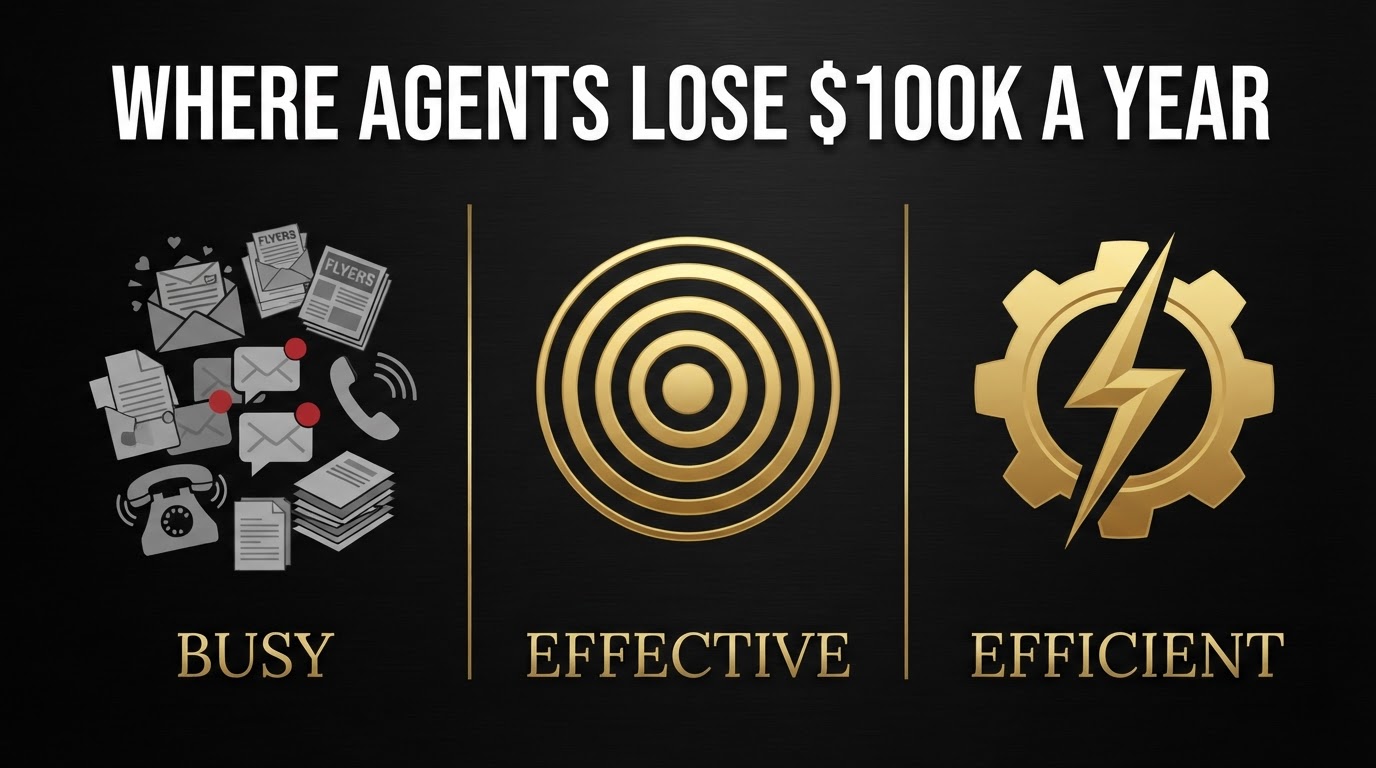
Ask any agent how business is going and you'll hear the same word: "Busy."
Busy is the most dangerous word in real estate. It feels like progress. It sounds like success. And it can hide the fact that you haven't had a real listing conversation in two weeks.
You can work 60 hours a week and be broke. I've watched it happen to talented people. Not because they were lazy — because they were busy doing the wrong things.
The Proof: I've Seen It From the Owner's Chair
I've owned brokerages with more than 100 agents, coached 500+ agents one-on-one and trained more than 2,500. When you sit in the owner's chair, you see something agents can't see about themselves: the hardest-working agents in the office are not always the highest-producing ones. The difference is almost never effort. It's what the effort goes into.
That's why Chapter 24 of The Millionaire Agent Playbook is about numbers, and Chapter 14 is about systems. Feelings lie. Numbers don't.
How to Move From Busy to Effective to Efficient
Run a One-Week Time Audit
Every hour for one week, write down what you did and label it B (Busy), E (Effective) or EF (Efficient). No judgment — just data.
Cut or Delegate the Top Three Busy Activities
Look at your audit. Pick the three Busy activities that ate the most time. For each one, decide: stop doing it, batch it into one small window, or hand it to someone else.
Move Effective Work Into Protected Time
Your Effective work gets the best hours of the day — your morning prospecting block — not the leftovers.
Systematize What Repeats
Anything you do more than twice a week should have a script, a template or a checklist. Scripts for calls. Templates for follow-up texts. Checklists for listing launches. That's how Effective becomes Efficient.
Track Weekly, Adjust Monthly
You can't improve what you don't measure.
Start by protecting the hours that pay. Get The Millionaire Schedule template + TMAP Chapter 1 free
Includes the exact daily prospecting calendar template and printable checklist.
The Three Levels
Level 1: Busy
Activity that fills time but doesn't create income.
- Re-designing your logo or flyer
- Scrolling "for ideas"
- Organizing your CRM instead of calling it
- Driving to drop off something that could have been sent
- Answering every email the minute it arrives
Busy feels productive because it's comfortable. Nobody rejects you while you're picking fonts.
Level 2: Effective
Activity that directly creates income.
- Prospecting conversations with sellers and buyers
- Lead follow-up
- Setting and going on appointments
- Negotiating contracts
- Calling your database
Effective is uncomfortable. That's usually how you know it's working.
Level 3: Efficient
Doing the effective work with less time, less friction and more consistency.
- Building tomorrow's call list today, so you start dialing the minute your block begins
- Using proven scripts instead of improvising
- Delegating paperwork and coordination
- Tracking numbers so you know exactly which activity pays the most
Most agents try to jump from Busy straight to Efficient — buying tools and apps to "optimize" — before they're Effective. That's just a faster way to be busy.
Where the $100K Goes: Run Your Own Numbers
Here's an exercise I want you to do with your numbers, not mine. The figures below are an example only — swap in your own.
Your numbers may be higher or lower. The point is this: busy work isn't free. Every hour has a price, and you pay it whether you look at it or not.
The Weekly Productivity Scoreboard
Track these every Friday:
| Number | Your Week |
|---|---|
| Hours of Effective work | ___ |
| Hours of Busy work | ___ |
| Contacts made | ___ |
| Appointments set | ___ |
| Appointments held | ___ |
| Contracts signed | ___ |
The goal isn't perfection. It's J.B.Y. — Just Beat Yesterday. Next week, one more Effective hour and one less Busy hour.
The Efficiency Trap
One warning. Once you start cutting Busy work, you'll be tempted to fill the time with "planning." More spreadsheets. More systems. More research on the perfect CRM.
Planning is good. Planning instead of calling is Busy wearing a suit. A simple rule: you don't get to work on your systems until you've finished your Effective block for the day.
The Question That Changes Everything
"Is this putting me in front of someone who can hire me, or is it helping me avoid that?"
That one question will save you more money than any app you'll ever buy.
Your One Action for Today
Today is Black Friday. Most agents are off. Grab a sheet of paper, draw three columns — Busy, Effective, Efficient — and list everything you did last week in the right column. Circle the biggest Busy item. Next week, it's gone.
Run your scoreboard alongside agents who track their numbers every week. Join the MIT community on Skool — accountability, scripts and live trainings for $49/month, with a free trial:
Join MIT on Skool →